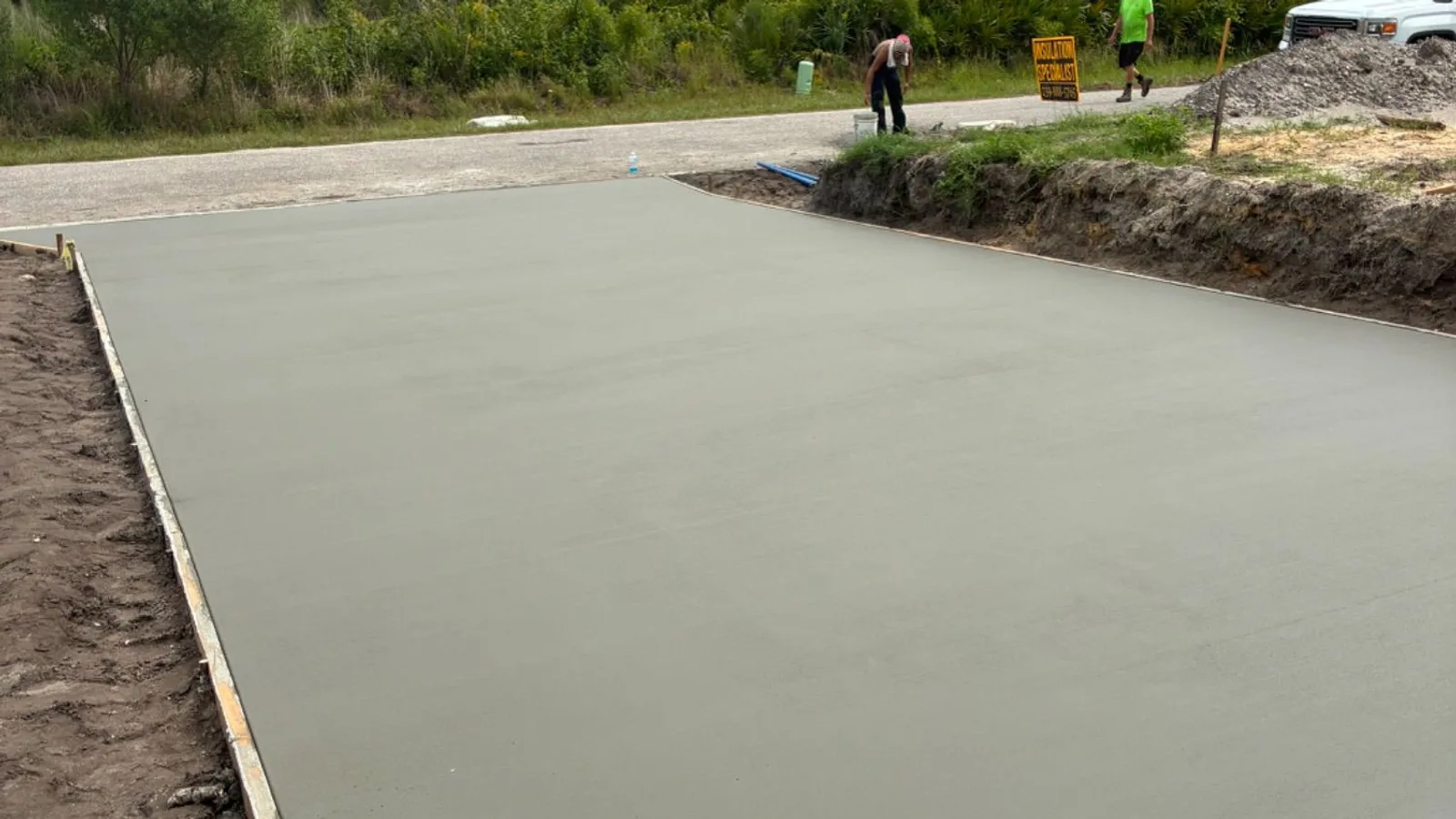
The most common question on pour day, right after the finish goes on: when can I use it? The short answer for a driveway is 24 hours to walk on it, 7 days before a car, 28 days before anything heavy. The longer answer is worth knowing, because the first month is when a slab decides how long it's going to last.
Concrete doesn't dry; it cures. The cement reacts with the water in the mix and grows crystals that lock the sand and stone together, and that reaction keeps going for weeks. At 24 hours the surface is hard enough to walk on. At 7 days the slab has reached roughly 70% of its design strength, which is enough for a car. At 28 days it's at full strength — the 3,000 or 4,000 PSI the mix was ordered at — and that's when a loaded pickup, a moving van or an RV is fine.
Florida makes curing harder than it is elsewhere, because heat and sun pull the water out of a slab before the cement has finished using it. A driveway poured at noon in July and left to bake can lose enough water in the first day that the top never reaches full strength — it dusts, it scales, it cracks in a fine map pattern. That's why we pour at first light, why we spray a curing compound on as soon as the finish is done, and why on a hot day we'll keep a slab damp for the first few days. If you see us wetting down your new driveway, that's what we're doing.
What you should do: keep everything off it for the first day, keep the caution tape up until we say, and keep the sprinklers from hitting it directly in the first week if we've asked you to. If a storm rolls in within a few hours of the pour, don't panic — we've covered it if it needed covering, and a little rain on a finished surface that has already set is fine.
What you shouldn't do: don't park on it early because it looks dry. Don't let the delivery truck back onto it in week two. Don't drop anchor bolts or a basketball hoop into it in the first week. Don't seal it yourself in the first month — a sealer applied on a slab that's still curing traps moisture and turns cloudy. And don't drag a steel-edged mower or a trailer jack across it, ever, really.
You might see a few things in the first weeks that look worrying and aren't. Hairline cracks at the control joints are the joints doing their job — that's where we told the slab to crack. A slightly different colour from one section to the next evens out as the whole thing cures. A white haze that appears and then fades is efflorescence, salts coming to the surface, and it washes off.
After the first month, new concrete needs very little: hose it off, keep the downspouts from dumping on one spot, and if it's stamped or coloured, a coat of sealer every three to five years. That's it. A driveway we pour this year, cured properly, is something your kids will still be parking on.
Have a slab that was poured and left to bake, or one that's scaling or dusting? Call David Garcia Concrete Services at (941) 321-6281 and we'll take a look. And if you're planning a new pour, ask us about the cure — it's the part of the job that happens after we leave, and we take it seriously.