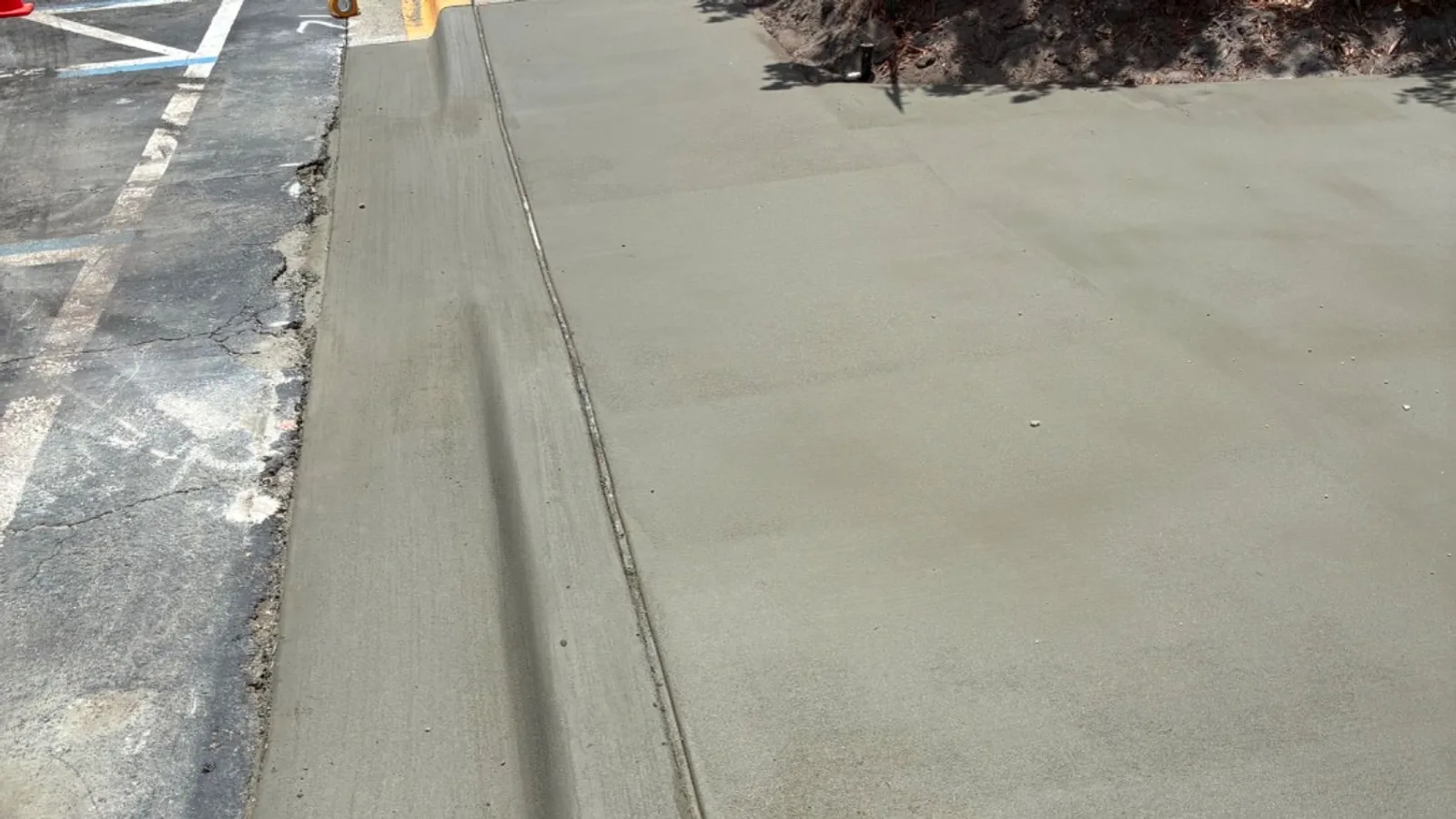
Almost every driveway in Sarasota and Bradenton that's more than twenty years old has cracks in it, and almost every homeowner with one eventually asks us the same thing: can this be fixed, or does it all have to come out? The honest answer is usually somewhere in between, and it depends on things you can see if you know where to look.
Start with the cracks themselves. A hairline crack that runs straight and hasn't opened up is cosmetic — concrete cracks, and if it cracked where a control joint should have been, it's just doing on its own what a saw would have done. Those get routed and sealed so water stays out of the base, and that's the whole job. A crack that's a quarter inch wide, that has one side higher than the other, or that you can see getting longer year to year is a different animal: it means the slab is moving, and the question becomes why.
Then look at the settlement. Stand at the street and look down the driveway. If one panel has sunk and the others are level, that panel's base washed out — usually a downspout, a broken sprinkler line or a spot that was never compacted. We cut that panel out, rebuild the base and re-pour it, and the rest of the drive is fine. If the whole drive has settled toward the garage, or the panels tilt in different directions, the base under all of it is bad, and re-pouring one panel just moves the problem next door.
Check the thickness at an edge if you can. A driveway that was poured at three inches — and a lot of 1960s and 70s drives were — is going to keep cracking no matter what is done to the surface, because it was never strong enough for a modern SUV. Overlays and patches on a thin slab fail from underneath. That's a replacement, and it's one we'll show you the reason for.
Surface problems are the good news. Spalling — the top flaking off in patches, usually where sprinklers hit or where salt from the coast has got in — looks awful and is fixable with a bonded overlay if the concrete under it is sound. Scaling, pitting and discolouration are the same story. A driveway can look terrible and be structurally fine, and those are the ones where a repair saves you real money.
The three situations where it stops being a judgment call: a slab that's cracked into a jigsaw with pieces moving independently; a slab that's been undermined by a washout or roots across most of its area; and a slab that's too thin or unreinforced and has already proven it by cracking everywhere. In those cases, the repair costs more over five years than the replacement does today, and we'll say so.
What we do on every estimate is the same: walk it with you, tap it, check the edges, look at where the water goes, and give you two numbers — repair and replace — so the decision is yours and it's made with the facts. Sometimes the answer is a $600 panel. Sometimes it's a new driveway that's wider, thicker and reinforced, and that's the last one the house will need.
Got a driveway, walk or patio you're not sure about? Call David Garcia Concrete Services at (941) 321-6281. We'll come out, tell you honestly whether it's a repair or a replacement, and give you a written price for whichever it is — free.