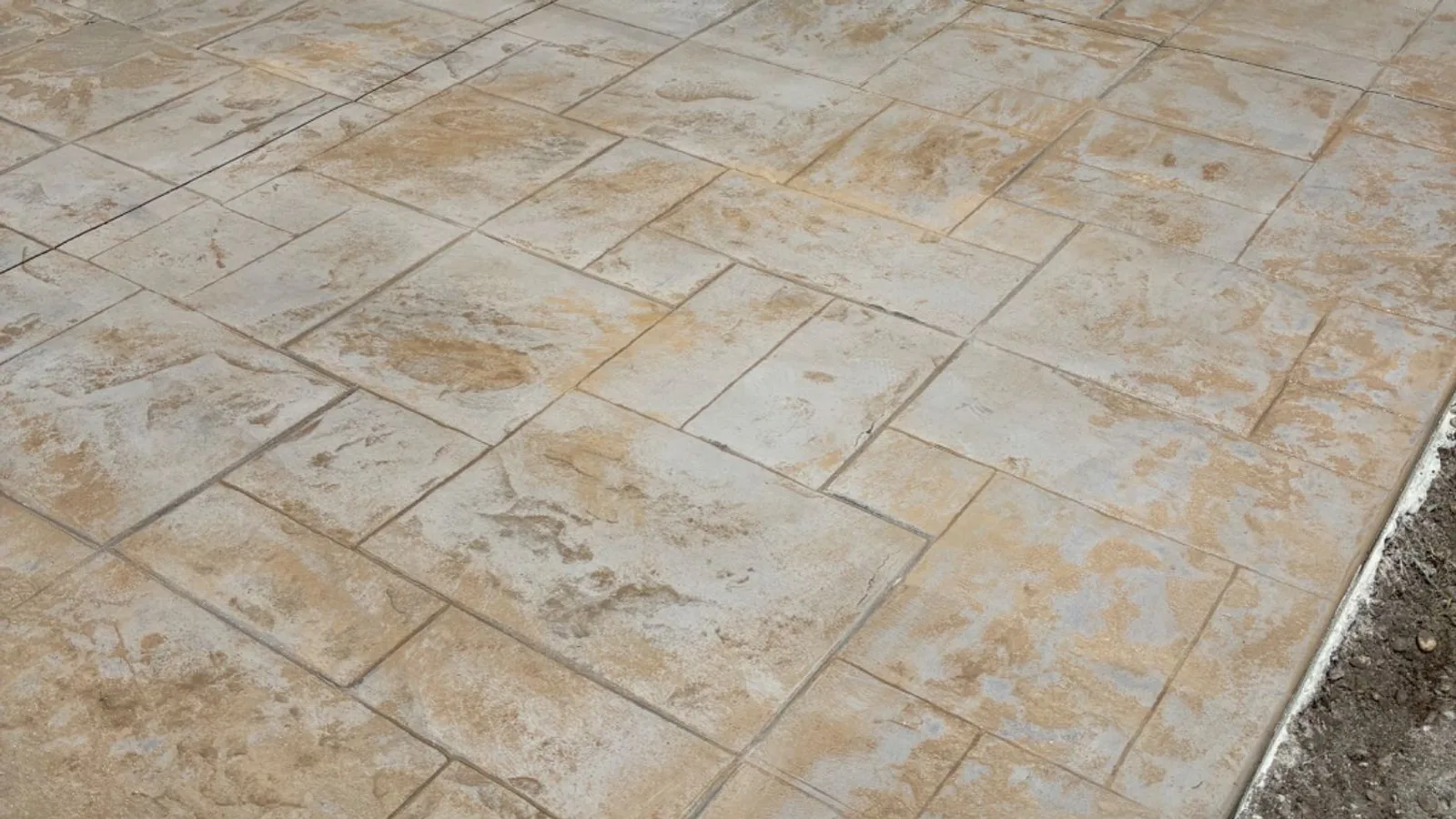
It's the question we get on almost every patio and pool-deck estimate: should this be pavers or stamped concrete? Both can look like natural stone. Both come in dozens of colours and patterns. And on the day the crew leaves, both look wonderful. The difference is what they look like — and what they cost you — five and ten years later, on the ground we have here.
Start with what's under them. A paver patio sits on a bed of sand over a compacted base, and each paver is its own piece. Sarasota, Manatee and Hillsborough are sand over shell over more sand, the water table is high, and every summer afternoon dumps an inch of rain on it. Sand under pavers moves. It washes out at the edges, it gets pumped up through the joints, and the pavers settle unevenly — a low corner here, a raised edge there, a trip hazard at the step. Polymeric sand in the joints helps for a few years and then it doesn't.
Then there are the ants and the weeds. Every joint between two pavers is a doorway. Fire ants build under them, big-headed ants push sand up through them, and whatever seeds blow in take root. You can treat, pull and re-sand, and it's a chore that never finishes.
A stamped slab is one piece of reinforced concrete, four inches thick, on a compacted base. There are no joints for anything to come up through — only the control joints we cut, which are sealed. It doesn't settle in pieces; a properly based slab doesn't settle at all. The pattern is pressed into the surface while it's plastic, the colour is in the mix and in the hardener on top, and a sealer locks it and makes it hose-off easy. Random flagstone, ashlar slate, cobble, brick, wood plank — we have stamps for all of them, and from ten feet away nobody can tell it from the real thing.
What about cost? Stamped concrete is usually less to install than a comparable paver job, because there's less labour in placing one slab than in setting several thousand blocks. Over the life of the patio the gap widens, because the paver patio needs re-sanding, re-levelling and weed and ant treatment, and the slab needs a coat of sealer every three to five years.
Where pavers do win: if something has to be cut into the patio later — a new gas line, a drain — you can lift pavers and put them back. A slab has to be saw-cut and patched, and the patch shows. And some people prefer the slight unevenness of real pavers as a look. Those are honest reasons, and if they matter to you, pavers are the right call.
One more thing about stamped concrete: it's only as good as the slab underneath. A stamp is a finish, not a shortcut. If a contractor is offering a stamped patio at a price that only works with three inches of concrete, no reinforcement and no base work, you'll get the cracks to prove it. Ask what's under the pattern.
Thinking about a patio, a pool deck or a lanai floor? Call David Garcia Concrete Services at (941) 321-6281. We'll bring the pattern and colour samples to your house, price stamped and plain side by side, and tell you honestly which one suits the job.